
An American tourist in Tokyo finishes a canned coffee, looks around for a trash can, and finds nothing. They walk a block, then another, scanning for a bin on the sidewalk, in the park, at the train station, and come up empty, eventually stuffing the can into a bag or a pocket in mild disbelief. This is one of the most reliably baffling experiences a first-time visitor to Japan has, because the country has almost no public trash cans, one of the lowest densities of any developed nation, and yet, impossibly, the streets are immaculate. Not a wrapper, not a bottle, not a cigarette butt.
How can a place with nowhere to throw anything away be cleaner than cities drowning in bins? The answer is a single, quiet national habit, and once you understand it, the missing trash can stops being an inconvenience and becomes one of the best windows you will ever get into how Japan actually works. Here is why the bins vanished, the habit that quietly replaced them, the deep culture that makes it hold, the strain it is now under, and how to handle it gracefully as a visitor. It is a far richer story than a simple tidiness stereotype, and it says something real about the country.
What follows is the paradox itself, the surprising reason the bins disappeared, the habit that keeps the streets clean, the deeper culture underneath it, and how to deal with your own trash in Japan.
The Paradox of the Spotless Empty Street

Let’s start with how genuinely strange this is, because it defies every intuition an American brings to it. In the United States, the unspoken logic of public cleanliness is that you keep streets clean by providing lots of trash cans, so that people have somewhere convenient to toss their litter; remove the bins, the thinking goes, and you get garbage everywhere. Japan does the exact opposite and gets the exact opposite result. There are vending machines on nearly every corner selling hot and cold drinks, convenience stores on every block, a whole thriving culture of grab-and-go food and drink, and almost nowhere public to dispose of any of the resulting cans, cups, and wrappers, and yet the sidewalks, parks, and train platforms are so clean they can feel almost unreal, even uncanny, to someone arriving from a big Western city where litter is simply part of the scenery. The contrast is not subtle; it is jarring.
This is the paradox that stops visitors in their tracks, and it is worth sitting with for a moment rather than rushing past, because the instinct is to assume there must be some hidden army of street cleaners constantly sweeping up behind everyone. There is not, at least not on a scale that could explain it. The cleanliness is not something done to the streets by an unseen workforce in the small hours; it is something done by the public itself, continuously, invisibly, by every single person, every day, as a matter of course. It is less a cleaning operation than a shared agreement. Understanding how a country keeps its streets spotless while refusing to give anyone a place to throw things away is the whole puzzle, and the solution is not a clever municipal trick but a habit so deeply shared that it has made the trash cans unnecessary in the first place.
The Surprising Reason the Bins Disappeared

First, though, the bins did not simply never exist; they vanished, and the reason is darker and more specific than most visitors imagine. On the morning of March 20, 1995, a doomsday cult carried out a coordinated sarin gas attack on the Tokyo subway during rush hour, releasing a lethal nerve agent on several train lines, killing commuters and sickening thousands in one of the worst acts of terrorism in the country’s modern history. In the aftermath, authorities looked hard at the vulnerabilities of the transit system, and one obvious one was the public trash can, an opaque container in a crowded station where anything, including a weapon, could be concealed.
So the bins came out, first from subway and train stations and then more broadly, as a security measure, and when further attacks struck other world cities in the years that followed, Japan quietly removed still more. What is fascinating is what happened next, or rather what did not: the streets did not fill with garbage. The security measure, meant to be practical, revealed something about the society that adopted it, which is that the Japanese public simply absorbed the inconvenience and adapted, and the temporary fix hardened into a permanent national default. Today, decades later, the bins are still largely gone, not because anyone is still acutely afraid of another attack on the subway, but because the country discovered, almost by accident, that it did not actually need them in the first place. The emergency measure quietly revealed a truth about the society it was imposed on. The culture underneath, it turned out, had never really depended on public bins at all, and the 1995 removal simply exposed that fact.
The Habit That Keeps the Streets Clean

Here is the whole secret, and it is almost absurdly simple: in Japan, you take your trash home. The guiding principle, sometimes rendered as gomi wa mochikaeri, carry your garbage back, is that your waste is your own responsibility, and the place to deal with it is not a public bin but your own home. When a Japanese person generates trash while out, a drink can, a snack wrapper, a receipt, a used tissue, the default is not to hunt around for somewhere to offload it onto the public but to simply carry it along with them until they get home, where it can be sorted into its proper category and disposed of correctly. The thought of leaving it behind for someone else barely arises. Many people habitually carry a small bag for exactly this, a little personal trash kit that quietly collects the day’s refuse.
That single habit, multiplied across a hundred and twenty million people, is the entire explanation. The streets are not clean because someone cleans them; almost nobody drops anything in the first place, because everyone is carrying their own small quantity of garbage home to deal with themselves. It is a profound inversion of the American model, in which keeping public space clean is treated as a service the city is supposed to provide through bins, budgets, and labor, and a dirty street is therefore the government’s failure rather than the public’s own. Nobody in that model feels personally implicated by the litter around them. In Japan the logic runs the other way entirely. In Japan it is a duty each person performs, personally, every day, without being asked or thanked.
The missing trash can is not a failure of public services; it is a monument to the fact that the public took the job on itself. Once you grasp that, the empty streets stop being mysterious and start being, frankly, a little humbling, because you are looking at the accumulated result of millions of people each quietly declining to make their small mess someone else’s problem.
The Culture Underneath It
A habit that demanding does not hold up on willpower alone; it rests on a deep cultural foundation, and seeing that foundation is where the trash-can question opens onto something much bigger about Japan. The attitude is instilled from early childhood, most strikingly in schools, students clean their own classrooms every day, a practice called souji that means there are far fewer janitors because the children do the work. Growing up cleaning the space you use with your own hands, every single day, rather than having an invisible adult clean up after you, builds a deep and lifelong sense that keeping shared space tidy is simply your own job, baked in before you are old enough to question it. By adulthood it is not a rule you follow but an instinct you have.
Several other threads reinforce it. There is a strong social norm against eating or drinking while walking or on trains, so people tend to consume things on the spot, by the vending machine or outside the shop, which conveniently means they finish and dispose of the packaging at the source rather than carrying food through the streets and shedding wrappers. There is the deep cultural weight placed on not causing meiwaku, trouble or nuisance to others, which makes littering feel not just illegal but genuinely shameful, an imposition of your mess on the community. And there is a famously rigorous system of sorting household garbage into many categories, burnable, non-burnable, plastics, bottles, cans, which both keeps people engaged with their waste and, incidentally, makes simple public bins impractical anyway, since a single can cannot accommodate the sorting the system requires. All of it points the same direction: cleanliness in Japan is not an outcome the government delivers to a passive public but a collective practice the whole society performs on itself, day after day, and the absence of bins is less the cause of the clean streets than a visible symptom of the mindset that produces them. Remove the mindset and all the bins in the world would not keep the streets clean; keep the mindset and you barely need any.
The Cracks in the System

It would be too neat to present all this as a flawless national utopia, because the system is genuinely under strain, and honesty requires saying so. The habit works beautifully when nearly everyone sharing the streets grew up inside it, but Japan now receives enormous numbers of tourists who did not, who arrive with the Western instinct that someone else handles the trash and who, finding no bins, sometimes simply drop things or overload the few that exist. In heavily visited places the strain shows. Litter has crept up in tourist-saturated spots like Kyoto to levels that genuinely distress residents, and in Nara the stakes are not merely aesthetic, because the town’s famous free-roaming deer have sickened and died from eating discarded plastic bags.
In response, a few places have started doing something that would once have seemed almost unthinkable: cautiously installing public trash cans again, trying to manage the litter that mass tourism brings. This does not mean the system has failed, only that a habit built on near-total shared participation struggles when a large share of the people on the street have not inherited it. For a thoughtful visitor, this is the opposite of a loophole; it is the strongest possible reason to handle your own trash with care, because you are a guest in a system that works only when people carry their own weight, and the deer of Nara are a quiet reminder that your discarded wrapper is not a victimless convenience. Respecting the habit is how you avoid being part of the problem that is slowly forcing the bins back.
How to Deal With Your Trash in Japan
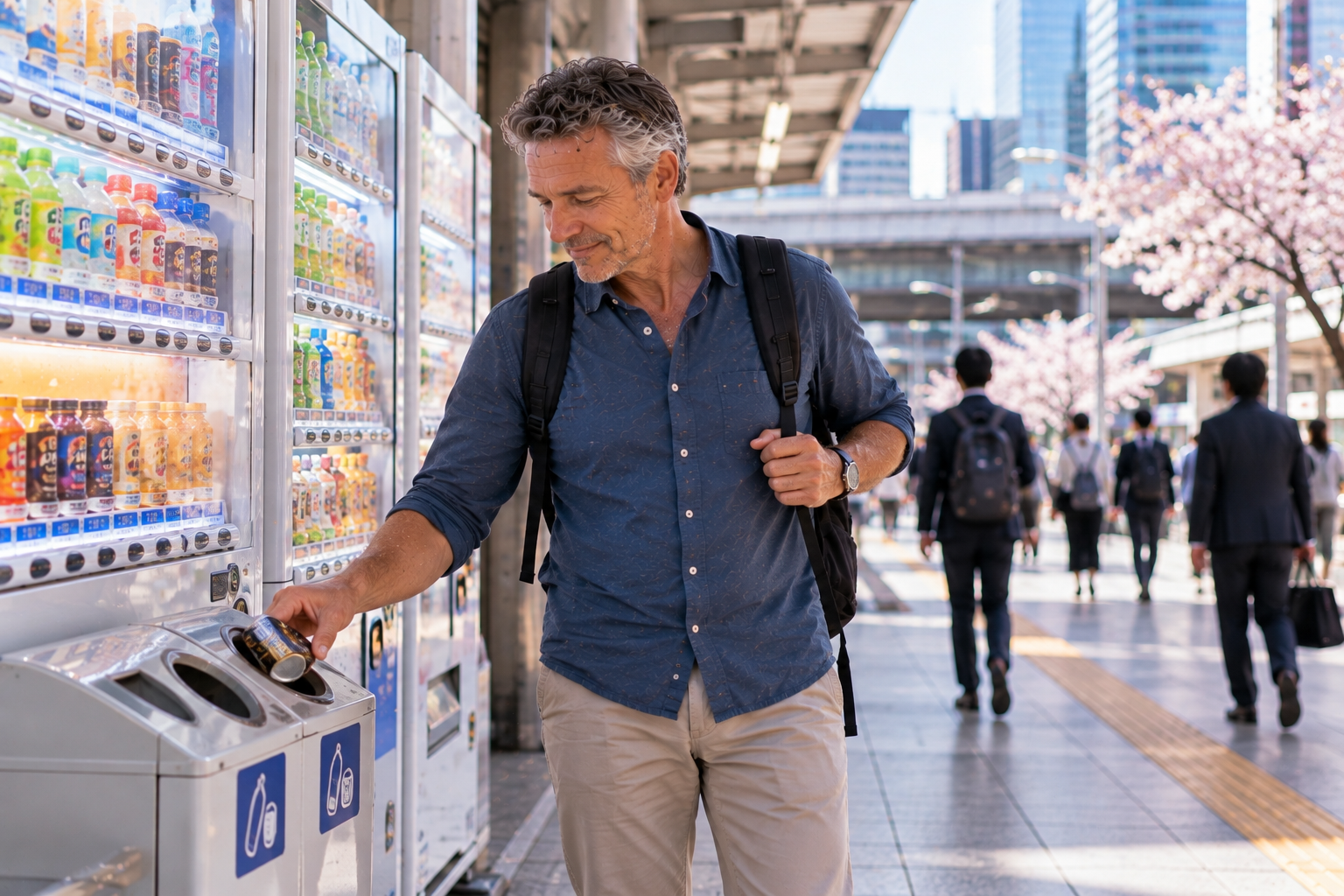
So what does a visitor actually do, caught between a grab-and-go culture and a near-total absence of public bins? The answer is to do what the locals do, which is easier than it sounds once you adopt the mindset. Carry a small bag in your daypack, and simply collect your own trash as you go, dealing with it back at your hotel, which has bins. This one simple move, the small bag in the daypack, solves almost the entire problem at a stroke and instantly makes you a far more considerate guest than the visitor wandering the city hunting in vain for a bin. It is the single most useful habit a traveler to Japan can pack.
Where bins do exist, use them correctly: convenience stores like 7-Eleven, FamilyMart, and Lawson usually have bins near the entrance, as do the areas around vending machines, but these are only quasi-public, intended for the packaging of things you bought right there, and stuffing a konbini bin with your hotel garbage is a recognized breach of etiquette, not a clever hack the locals somehow missed. Treat them as a courtesy, not a public dump.
Two more habits smooth the way. Follow the local lead and eat or drink on the spot where you buy something rather than wandering off with it, which lets you dispose of the packaging right there at the vending machine or store and spares you carrying it.
And lower your expectations of finding public bins while raising your tolerance for carrying things, because airports, large malls, and major tourist streets do have more bins, run by private operators, but the ordinary street mostly will not. Handling your own trash thoughtfully is not just a matter of personal etiquette but a small act of respect for the place. Do it for a few days and something genuinely shifts in how it feels: the missing trash can stops registering as a lack or an annoyance and starts feeling almost like an invitation, into a quieter, more collective, more grown-up way of moving through the shared world, one where everyone simply carries their own small share and the streets stay spotless not by magic or by hidden labor but by millions of tiny, invisible, daily acts of care. Few travel lessons stay with people longer than that one.

About the Author: Ruben, co-founder of Gamintraveler.com since 2014, is a seasoned traveler from Spain who has explored over 100 countries since 2009. Known for his extensive travel adventures across South America, Europe, the US, Australia, New Zealand, Asia, and Africa, Ruben combines his passion for adventurous yet sustainable living with his love for cycling, highlighted by his remarkable 5-month bicycle journey from Spain to Norway. He currently resides in Spain, where he continues sharing his travel experiences with his partner, Rachel, and their son, Han.