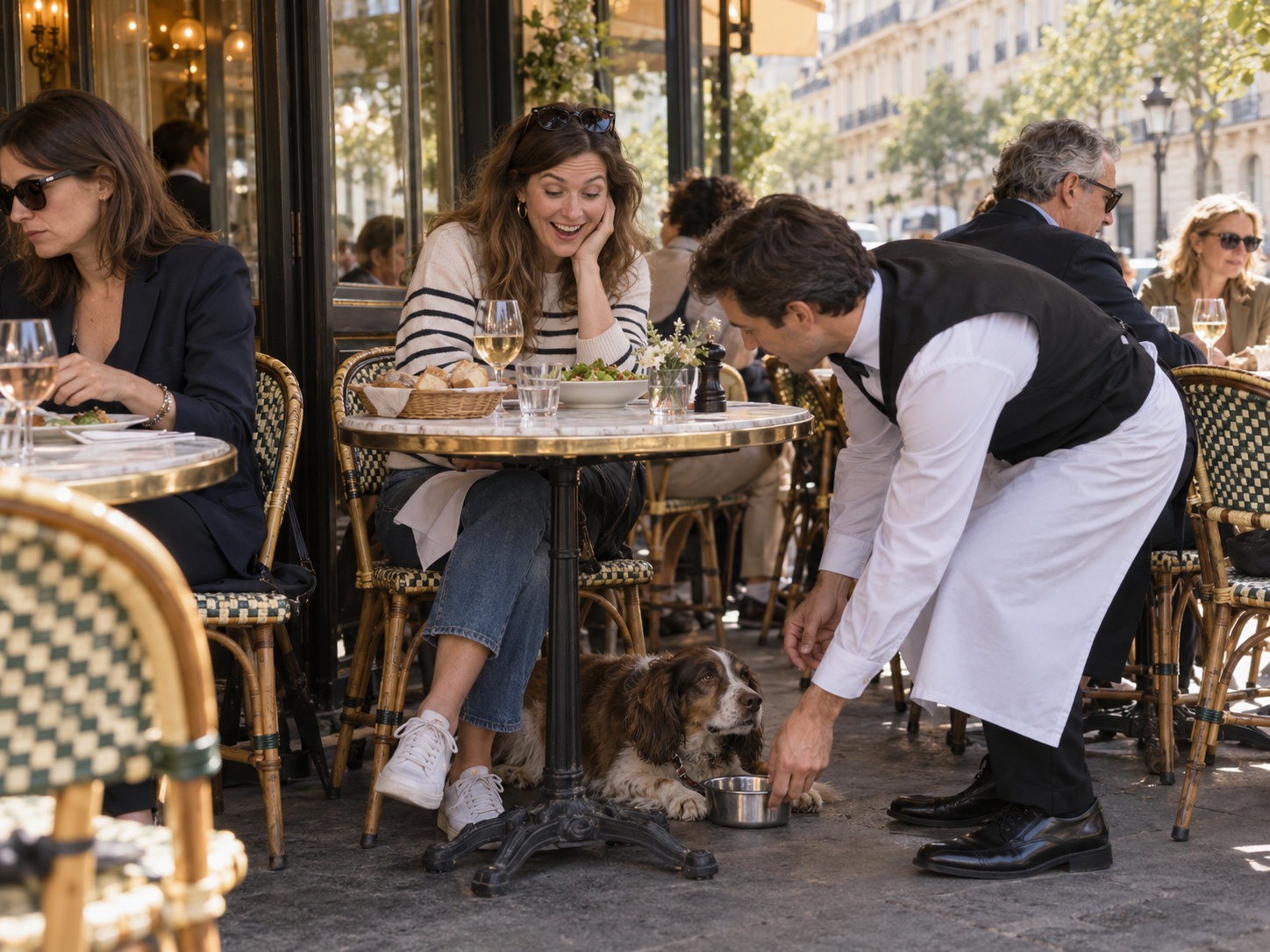
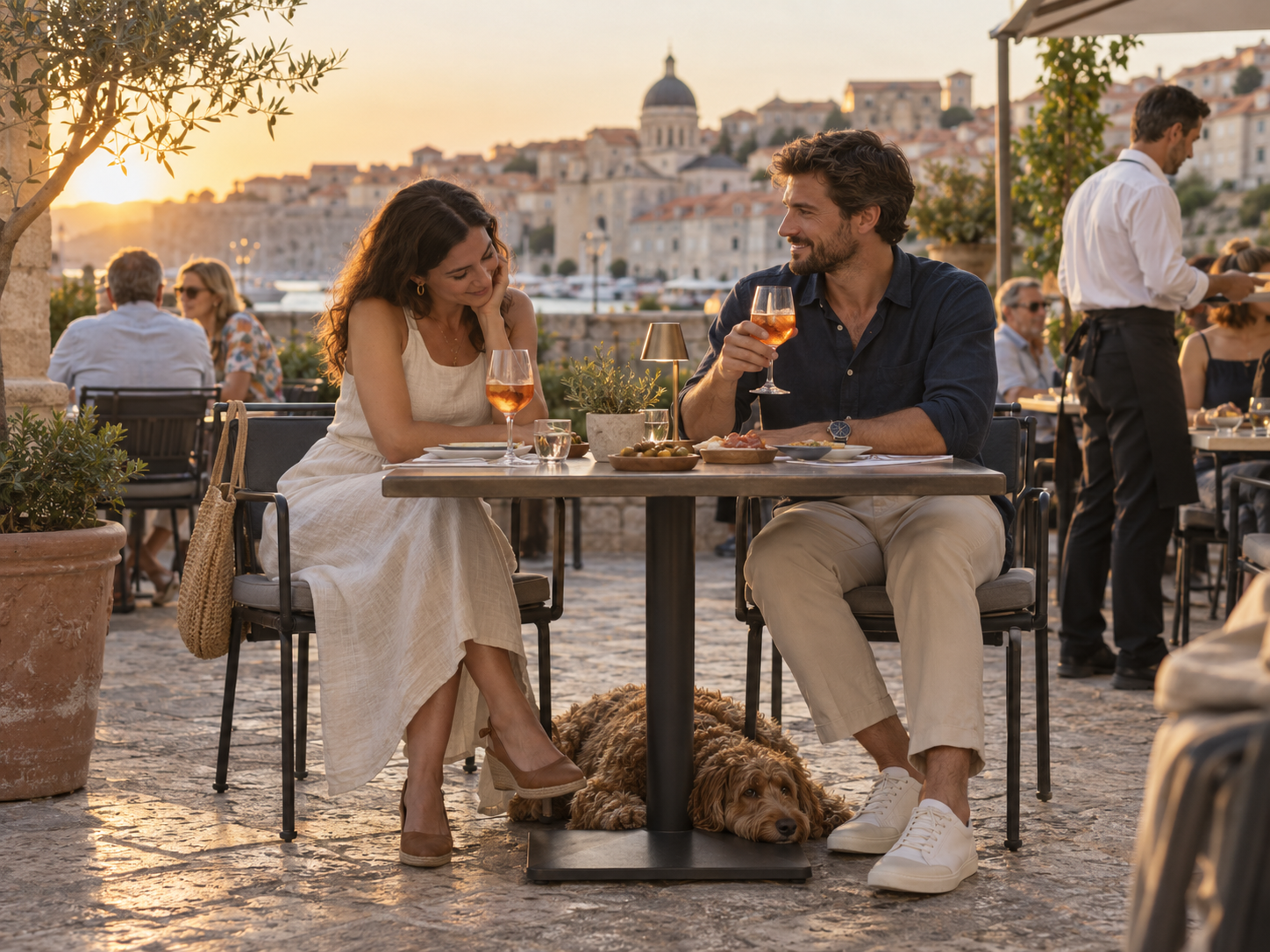
An American sits down for lunch in a Paris cafe and notices, with a little jolt of delight, that there is a dog lying under the next table. Not a service dog, not a special exception, not a tiny thing in a handbag, just someone’s ordinary medium-sized pet, curled quietly on the floor beside its owner’s chair while the owner works through a leisurely two-hour lunch, and the astonishing part, to American eyes, is that absolutely nobody is reacting.
The waiter stepped over the dog without comment. The other diners have not glanced at it twice.
At some point a server may even have brought the dog a bowl of water without being asked. To an American, for whom a dog in a restaurant means at best a sign reading well-behaved dogs welcome on the patio, this looks like proof that Europeans simply love dogs more. But the calm dog under the table is telling you something more interesting than that, and it is a set of unwritten rules that American visitors, with their own beloved dogs in tow, break all the time without realizing. Here is the scene that charms every visitor, the invisible rules that make it possible, why European dogs behave so differently, how far the custom extends beyond the restaurant, and how to earn the privilege rather than accidentally wreck it. It is one of those travel delights that turns out to have a whole philosophy tucked underneath it.
What follows is the welcome that surprises Americans, the unwritten rules behind it, why European dogs are so different, the mistakes visitors make, and how to do it right.
The Scene That Charms Every American
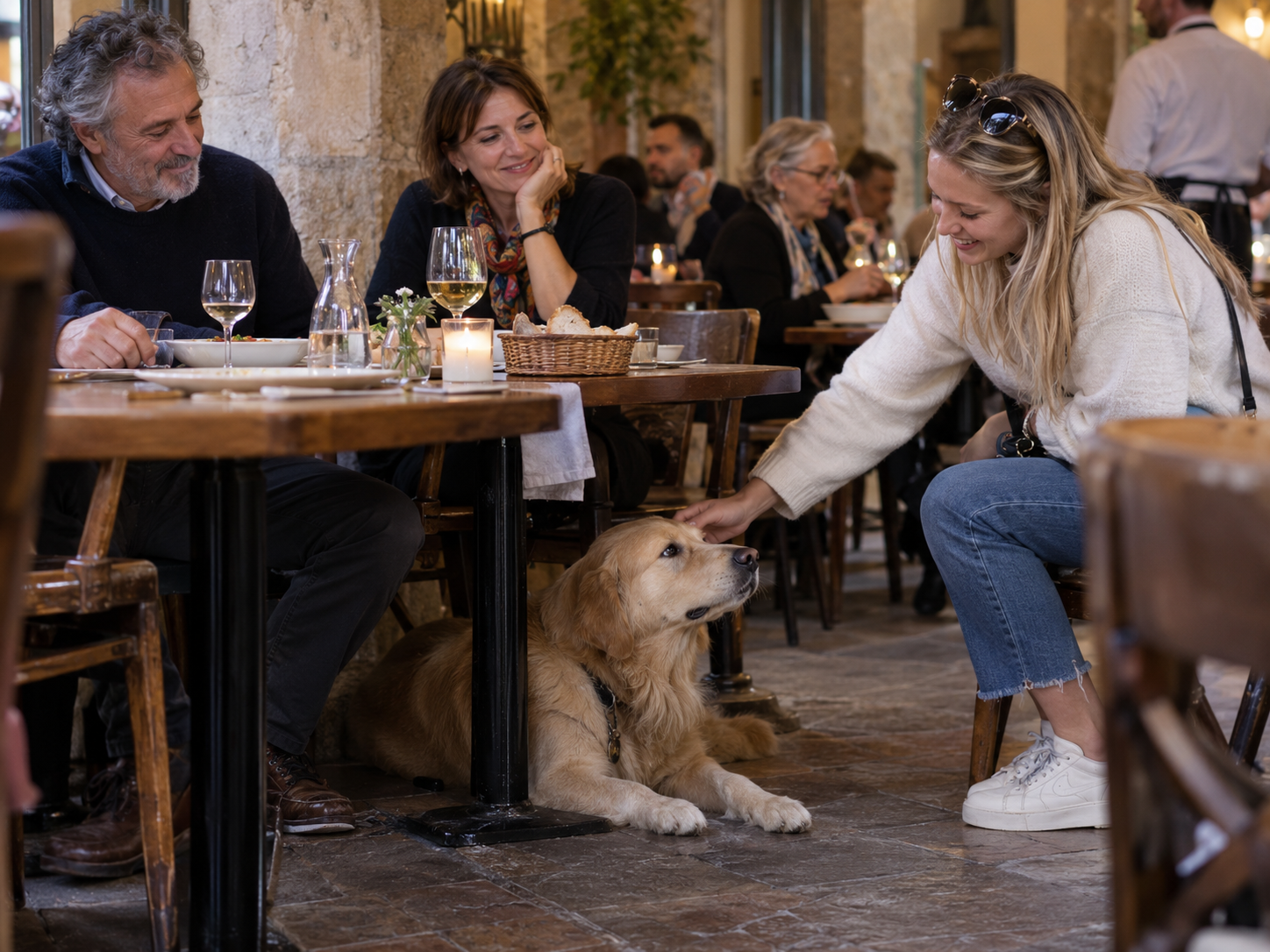
The sight really is everywhere once you start noticing it. Across much of Europe, in France, Germany, Italy, the Netherlands, Austria, Switzerland and beyond, dogs are welcome inside cafes, restaurants, bars, shops, and on trains, trams, and buses, as an ordinary part of daily life rather than a grudging exception. France is the spiritual home of this, the land of the cafe dog, where a waiter will often bring a water bowl before even taking your order, and where dogs wait in bakeries and sit beside their owners through a Saturday lunch that stretches past three in the afternoon. The dog is simply assumed to belong wherever its owner belongs, no questions asked, no special pleading required. The default is yes, where the American default is a firm and automatic no.
For an American, raised on health-code signs and dogs-outside-only rules, this is genuinely enchanting, and the easy conclusion is that Europeans are just more relaxed and more dog-loving than Americans are. There is a sliver of truth in that, but it badly misses the real story. What makes the scene possible is not a continental shrug about hygiene or a bottomless tolerance for animals underfoot. It is something far more specific and far more demanding, a quiet contract between dog, owner, and everyone else in the room, and the reason the other diners do not blink at the dog under the table is that the dog is holding up its end of that contract so completely that it has become, in effect, invisible. The charm is real, but it rests on a foundation most visitors never notice, and understanding that foundation is the difference between enjoying the custom and accidentally ruining it.
The Unwritten Rules That Make It Possible
So here is the contract, the set of rules nobody posts on a wall because everybody local already knows them. The first and most important is that the dog must be, for all practical purposes, invisible. It lies quietly on the floor, under or beside the table, and it stays there. It does not wander to other tables, it does not beg, it does not bark or whine, it does not jump up on the seats or put its paws on the table, and it does not approach or solicit attention from other diners.
A European restaurant dog is expected to settle in, switch off, and wait, treating the restaurant as a fundamentally calm and boring place where nothing is required of it but patience and a good nap. The best compliment you can pay such a dog is to forget it is there at all, which is precisely what the whole room does. That stillness is the whole reason it is welcome.
Around that central rule sit a handful of others. The owner is fully responsible for the dog’s behavior and for cleaning up after it anywhere in public, with real fines in many places for failing to do so. The welcome is not universal or guaranteed, so a considerate owner always checks, looking for a sign or simply asking at the door, because some establishments, grocery stores and many Asian restaurants among them, do not allow dogs at all, and a sign reading something like Hunde verboten means exactly what it looks like and is not a suggestion. The default may be yes, but the polite owner confirms it rather than assuming. And there is a rule for everyone else in the room, including tourists charmed by the dog: you do not pet or feed a stranger’s dog without asking, because that dog is quietly working at being calm, and unsolicited attention from an excited stranger undermines the very behavior that earns it a place at the table. The freedom to bring a dog into a restaurant, in other words, is inseparable from a thick web of responsibility, and the relaxed scene an American admires is actually the product of everyone, dogs included, following a fairly strict set of expectations.
Why European Dogs Are So Different
This raises the obvious question: how are European dogs so consistently, almost eerily well-behaved in public, when a lot of American dogs would lose their minds in the same situation? The answer is not breed or temperament but upbringing. European dogs are socialized to public life from early puppyhood, taken everywhere, exposed constantly to crowds, noise, other dogs, and restaurants, and trained to be calm and unreactive in exactly these settings. A dog that spends its whole life being brought along learns that a cafe is a boring place to nap, not an exciting place to react, and the result is an animal so under control that it can often be trusted off-leash on a busy street without fuss.
American dog culture, by contrast, tends to produce a different kind of dog, not worse-loved but differently raised. Many American dogs are kept mostly at home or in yards, socialized far less to busy public spaces, and rewarded, often unintentionally, for excitement and friendliness rather than for calm aloofness.
The adorable, bouncy, people-greeting American dog is a genuine delight in a backyard or a dog park and a quiet disaster under a restaurant table, through no fault of its own, because it has simply never been taught that the job, in public, is to switch off and disappear. It was raised to be a charming extrovert, and now it is being asked to be furniture, and it has no idea how. This is the crux of the whole difference, and it is worth saying plainly: Europe does not allow dogs in restaurants because Europeans love dogs more, but because European dogs are trained to behave in a way that makes their presence genuinely unobtrusive. The privilege follows the training, not the affection. The calm dog under the Paris table earned its spot through years of being socialized for exactly that moment.
The Rules American Visitors Break
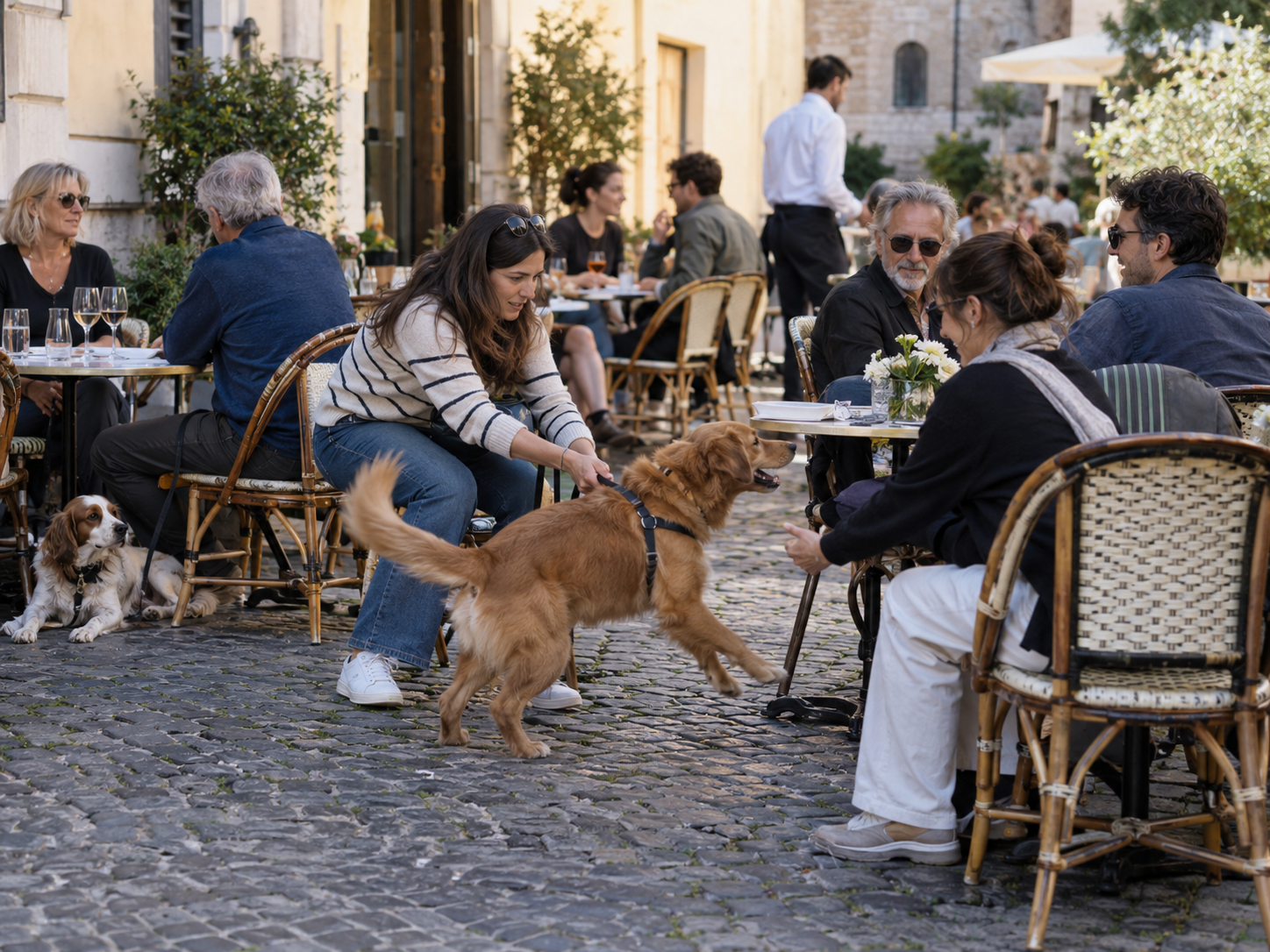
Here is where the well-meaning American gets into trouble, usually by assuming the privilege is about dog-friendliness when it is actually about dog-behavior. The traveler who brings their own dog to Europe, delighted to discover a restaurant-friendly continent, often brings a dog raised the American way, loving and excitable and utterly unprepared to lie still and ignore the world for two hours. Turned loose in a European restaurant, that dog does exactly what it was raised to do: it strains toward other tables, greets strangers, begs, fidgets, maybe barks, and in doing so breaks the invisible contract the whole system depends on. The owner, meanwhile, is often charmed by their dog’s friendliness and does not even register that anything is wrong.
The other common mistake is aimed at other people’s dogs. The American visitor, enchanted by the well-behaved dog under the next table, reaches over to pet it, which feels like a friendly tribute but is actually a small sabotage, pulling a working, settled dog out of its calm and encouraging exactly the attention-seeking the dog has been trained to suppress. Add to this the traveler who does not bother to check whether a place allows dogs and simply barges in where they are not welcome, or who fails to clean up after their dog in a culture that quietly fines you for it, and you have assembled the full set of ways a well-meaning American abroad can turn a lovely, trusting custom into a headache for everyone around them. None of it comes from bad intentions; all of it comes from mistaking a system built on training and restraint for one built on simple permissiveness. The custom is generous, but it is not a free-for-all, and treating it like one is precisely how visitors wear out their welcome.
It Goes Far Beyond the Restaurant
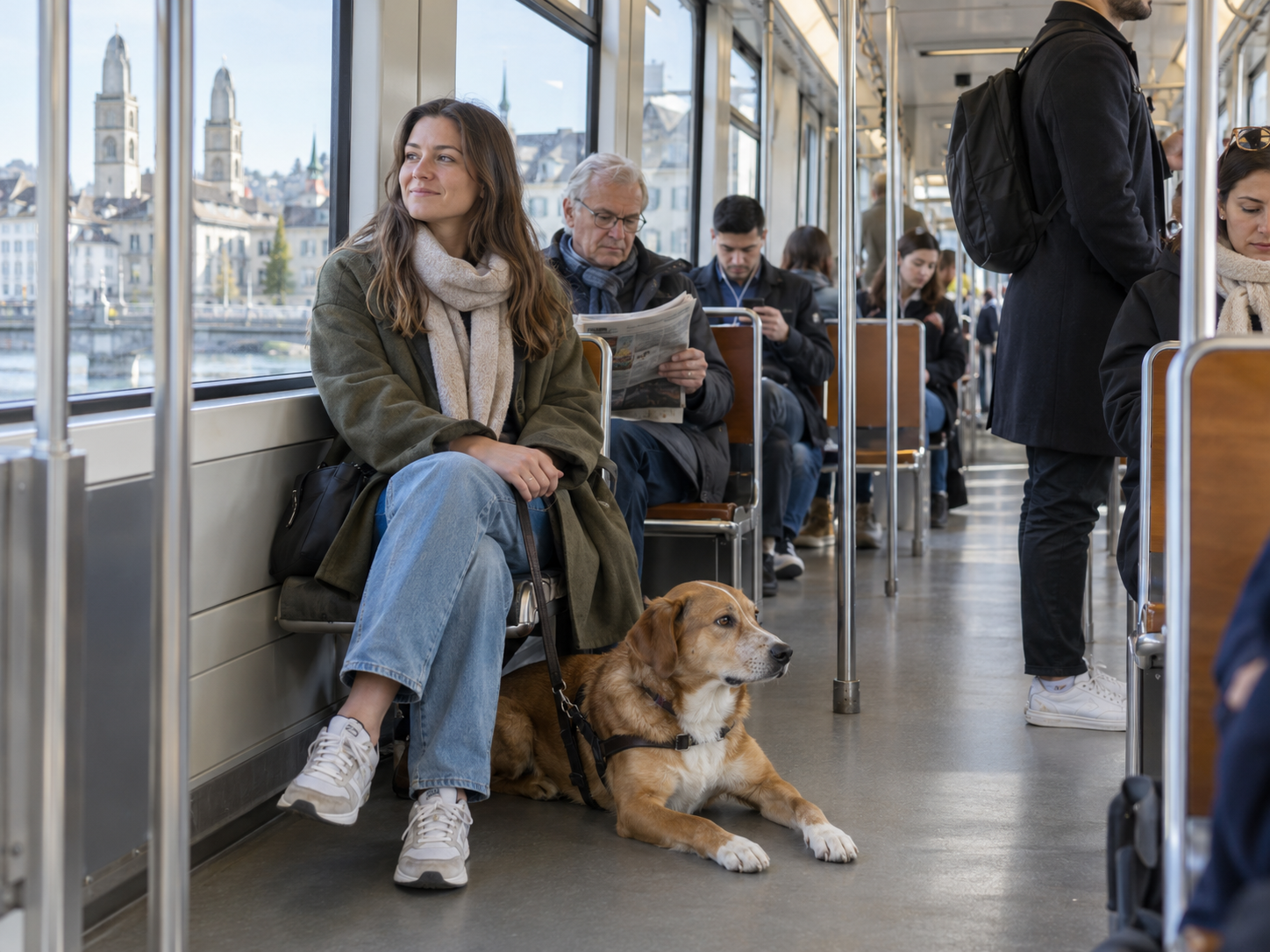
The restaurant is only the most charming window onto something much larger, which is that in much of Europe a dog is treated as a genuine participant in public life rather than a creature to be left at home. The same calm, trained dog that naps under the lunch table rides the metro and the tram and the intercity train, often for free or a small fare, waits patiently outside the few shops that do not admit it, accompanies its owner to the hardware store and the bank and sometimes the office, and is, in short, simply along for the day in a way that would be unthinkable in most of America. The dog is woven into daily life, not sequestered from it.
This is the deeper thing the restaurant scene is pointing at, and it explains why European dogs are the way they are, because a dog that goes everywhere, all the time, from puppyhood, has no choice but to become unflappable about the world. The constant exposure is the training. An American dog that rides in the car to the park and otherwise stays home has a small, exciting world in which every outing is an event; a European dog for whom the entire public realm is just Tuesday has learned to find all of it profoundly boring, which is exactly the temperament that makes it welcome everywhere. The dog under the table and the dog on the train and the dog dozing in the shop doorway are all the same achievement, the product of a culture that decided dogs could share public space and then did the patient work, dog by dog, generation by generation, to make that actually workable.
How to Earn the Privilege
So how does a dog-owning American actually participate in this rather than ruin it? The honest answer is that it starts long before the trip, with training, because the privilege is earned by behavior and cannot be faked on arrival. A dog that has been genuinely socialized to be calm in public, that can settle under a table and ignore the world on command, will be as welcome in Lyon as any local dog; a dog that has not will be miserable and disruptive no matter how friendly it is, and the kind thing, as well as the polite thing, is not to put it in that position. If your dog is not there yet, the move is to work patiently on calm public behavior at home and in low-stakes settings first, and above all to be honest with yourself about whether your dog is genuinely ready, rather than hopeful. A restaurant full of strangers is not the place to find out that it is not.
On the ground, the rules are simple once you understand the spirit behind them. Keep your dog on the floor under the table, not on the seats.
Keep it quiet and settled, and take it outside if it cannot settle.
Check for signs or ask before entering, and never assume. Clean up without fail.
And when you are the one without a dog, admiring someone else’s, keep your hands to yourself unless invited, letting the calm dog stay calm. Do all that, and you are not just following rules; you are joining a quietly beautiful piece of European life, the one where a dog can be a full participant in the public world because it has been taught to deserve that trust. The dog under the restaurant table is not a sign that anything goes or that Europe is simply more easygoing. It is a sign that everything, the dog’s years of training, the owner’s quiet responsibility, the other diners’ learned restraint, is working so smoothly and so invisibly that it looks like nothing at all. That invisible competence is the whole achievement, and it is well worth joining rather than breaking.

About the Author: Ruben, co-founder of Gamintraveler.com since 2014, is a seasoned traveler from Spain who has explored over 100 countries since 2009. Known for his extensive travel adventures across South America, Europe, the US, Australia, New Zealand, Asia, and Africa, Ruben combines his passion for adventurous yet sustainable living with his love for cycling, highlighted by his remarkable 5-month bicycle journey from Spain to Norway. He currently resides in Spain, where he continues sharing his travel experiences with his partner, Rachel, and their son, Han.